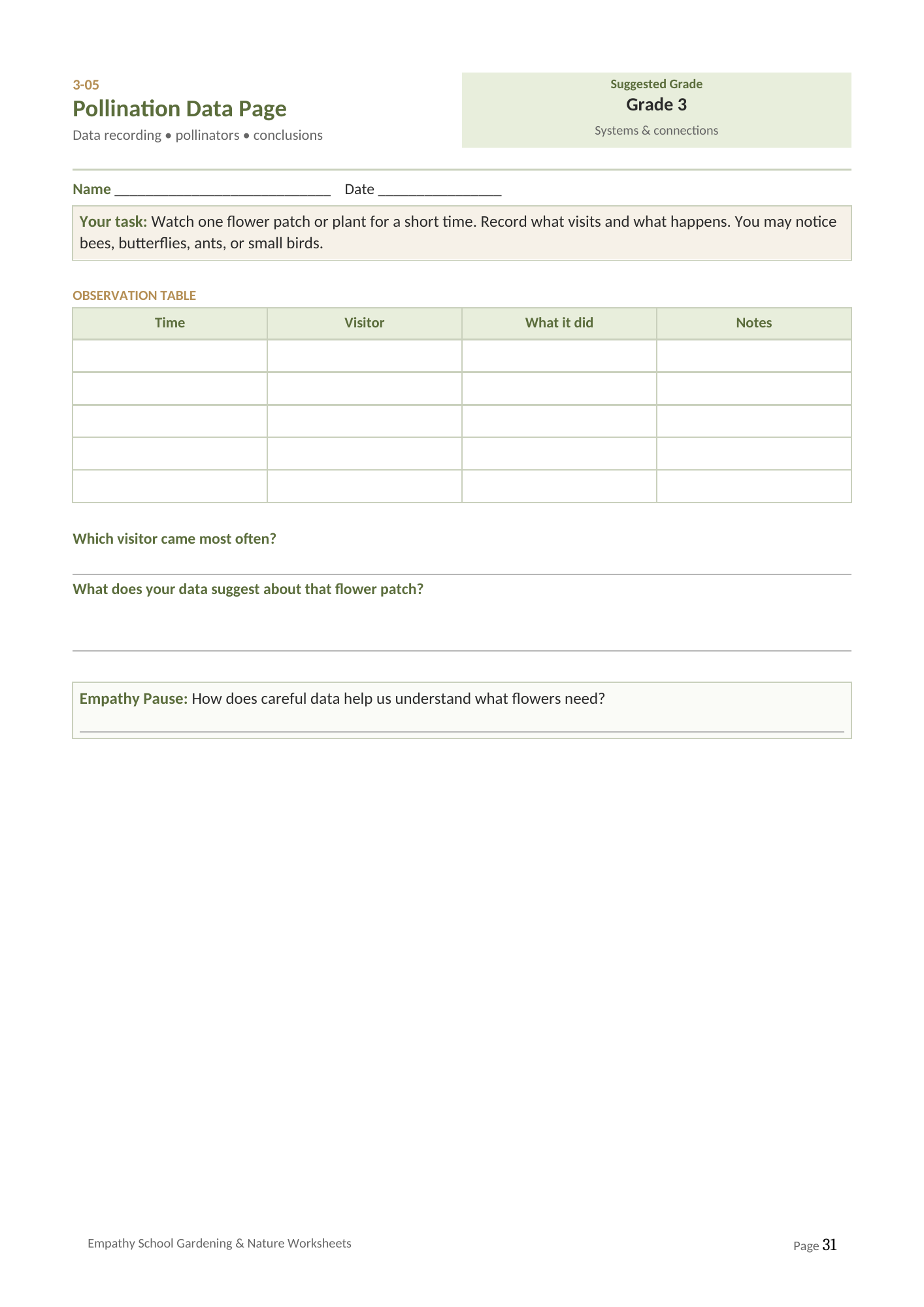
Sit by a flowering plant for ten minutes. Record every visitor.
This produces real data with real variance. Some ten minute sessions give twelve visits and some give none, and the class discovering that variation is the beginning of understanding why scientists repeat things.
Time of day matters enormously, which the sheet asks them to record and which explains most of the differences.
The page has the observation frame, a visitor key, and a class aggregation table. Aggregating everyone's data is the important last step. Twenty ten minute sessions pooled is a genuinely respectable data set and it looks like one when charted.
Eric Gonzalez-Payne
Founder and curriculum author
Ed.M. in Educational Leadership, Harvard Graduate School of Education
Published by Empathy Global LLC
LinkedIn
For the full social and emotional learning programme, see the Empathy Curriculum at empathy.kids.